Petrol Diesel Price Hikes India: Why Fuel Prices May Continue Rising Despite Global Market Relief

Fuel prices in India may continue facing upward pressure despite occasional declines in global crude oil prices, according to energy market analysts. The growing concern around petrol diesel price hikes India is being linked to geopolitical tensions, rising import dependency, currency fluctuations, refining costs, and increasing global energy uncertainty.
Although retail fuel prices have remained relatively stable in recent months, experts warn that several economic and international factors could still trigger future price increases.
The issue remains highly sensitive because rising fuel costs directly impact transportation, inflation, logistics, and household expenses across the country.
Why Fuel Prices Matter So Much in India
The discussion around petrol diesel price hikes India is important because fuel prices affect almost every sector of the economy.
Higher petrol and diesel prices can increase:
- Transportation costs
- Food prices
- Delivery expenses
- Manufacturing costs
- Household inflation
Diesel is especially critical because it powers a large part of India’s logistics and commercial transport network.
India Depends Heavily on Crude Oil Imports
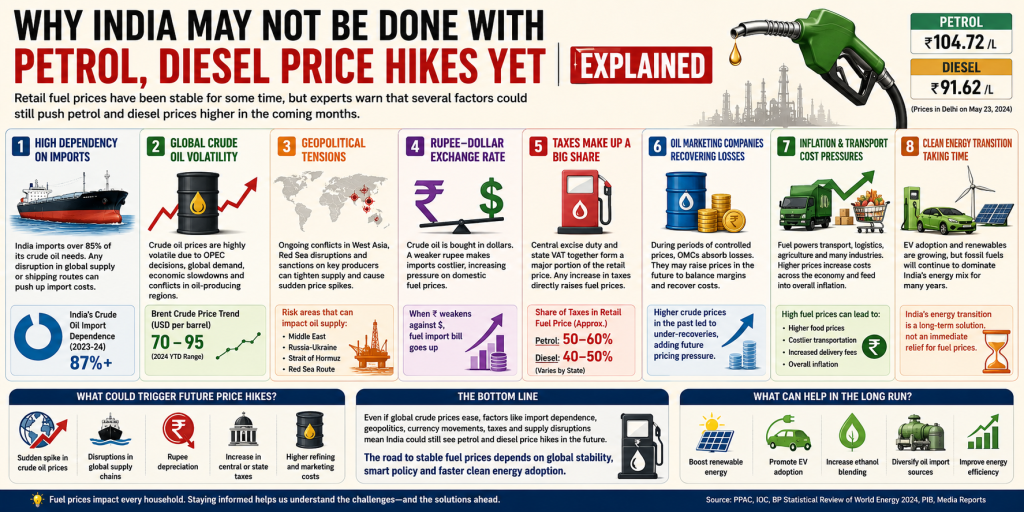
One of the biggest reasons behind possible petrol diesel price hikes India is the country’s heavy dependence on imported crude oil.
India imports a large majority of its oil requirements from international markets, making domestic fuel pricing vulnerable to global developments.
Any disruption in global supply chains or geopolitical conflict can quickly impact import costs.
Global Geopolitical Tensions Remain Risky
Experts say ongoing geopolitical instability remains a major reason why petrol diesel price hikes India may not be over yet.
Global tensions involving major oil-producing regions can affect:
- Crude oil supply
- Shipping routes
- Insurance costs
- Energy market confidence
Even temporary disruptions in oil-producing regions can trigger sharp price fluctuations globally.
Rupee-Dollar Exchange Rate Also Matters
The value of the Indian rupee against the US dollar plays a major role in petrol diesel price hikes India.
Since crude oil is traded internationally in dollars:
- A weaker rupee makes imports more expensive
- Oil marketing companies face higher costs
- Fuel pricing pressure increases domestically
Currency volatility can therefore impact retail fuel rates even when global crude prices remain stable.
Crude Oil Prices Still Volatile
Although international crude oil prices have occasionally softened, analysts say markets remain highly unpredictable.
The debate around petrol diesel price hikes India continues because crude oil prices are influenced by:
- OPEC production decisions
- Global economic conditions
- War-related uncertainties
- Energy demand fluctuations
Sudden spikes in crude oil prices can quickly affect domestic fuel pricing.
Government Taxes Play Big Role
Taxes remain a major component behind petrol diesel price hikes India.
Retail fuel prices include:
- Central excise duties
- State-level VAT taxes
- Dealer commissions
Experts say tax structures significantly influence final petrol and diesel prices paid by consumers.
Oil Companies Recovering Earlier Losses
Another reason linked to petrol diesel price hikes India is the financial pressure faced by oil marketing companies.
During periods of controlled pricing, companies sometimes absorb losses when international crude prices rise sharply.
Analysts believe companies may later attempt to balance margins through future pricing adjustments.
Transport and Inflation Concerns Growing
The fear surrounding petrol diesel price hikes India is closely connected to inflation concerns.
Higher fuel prices can increase:
- Public transportation fares
- Agricultural transportation costs
- E-commerce logistics expenses
This often leads to broader inflation across multiple consumer sectors.
Electric Vehicles Still Not Dominating Yet
Although India is promoting electric mobility, experts say EV adoption is still not large enough to immediately reduce fuel dependence significantly.
As a result, petrol diesel price hikes India continue affecting millions of consumers who still rely heavily on conventional vehicles.
The transition toward cleaner mobility is expected to take several more years.
Renewable Energy Push Continues
India is increasingly investing in alternative energy solutions to reduce long-term exposure to oil market volatility.
Government initiatives linked to energy security include:
- Electric mobility
- Green hydrogen
- Ethanol blending
- Solar energy expansion
However, experts say fossil fuels will continue playing a major role in the near future.
Consumers Watching Fuel Prices Closely
The issue of petrol diesel price hikes India remains politically and economically important because fuel prices directly affect daily life for ordinary citizens.
Consumers are closely monitoring:
- International crude trends
- Government tax decisions
- Oil company pricing policies
Even small fuel price changes can significantly impact monthly household budgets.
Conclusion
The growing concerns around petrol diesel price hikes India reflect the country’s continued vulnerability to global oil market volatility, currency fluctuations, geopolitical tensions, and import dependence. While temporary relief in international crude prices may offer short-term stability, experts believe several underlying risks could still push fuel prices higher in the future.
As India continues investing in energy diversification and alternative fuels, managing fuel inflation and long-term energy security is expected to remain a major economic priority.
Image Source: Unsplash
Also read: Delhi Heat Outdoor Workers Struggle as Most Earnings Spent on Buying Water Amid Extreme Temperatures
Add The News Pixel as a preferred source on Google- Click Here