
Reverse Aging Drug Trial Begins in First Human Study: Can Aging Really Be Reversed?

For centuries, humanity has searched for ways to slow down aging, extend lifespan, and maintain health in later years. While advances in medicine have significantly increased life expectancy, aging itself has remained an unavoidable biological process. Now, a groundbreaking Reverse Aging Drug Trial is bringing scientists closer than ever to answering a question once considered science fiction: Can aging actually be reversed?
Researchers have launched one of the first human studies designed to investigate whether a drug can slow, halt, or even reverse certain biological markers associated with aging. The development has generated enormous interest among scientists, healthcare professionals, investors, and the general public.
While the results are still pending, the Reverse Aging Drug Trial marks a significant milestone in longevity research and could potentially transform the future of medicine.
What Is a Reverse Aging Drug Trial?
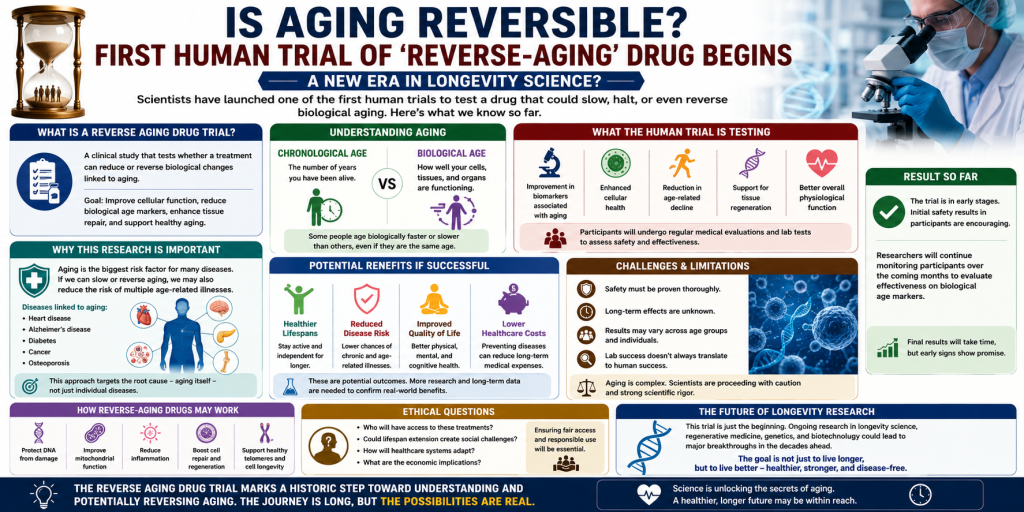
A Reverse Aging Drug Trial is a clinical study that tests whether a treatment can reduce or reverse biological changes linked to aging.
Unlike traditional treatments that target specific diseases such as diabetes, heart disease, or cancer, anti-aging therapies focus on the aging process itself.
Researchers aim to determine whether the drug can:
- Improve cellular function
- Reduce biological age markers
- Enhance tissue repair
- Support healthy aging
- Delay age-related diseases
The ultimate goal is not simply to help people live longer but to help them remain healthier as they age.
Understanding Biological Aging
The concept behind the Reverse Aging Drug Trial relies on the distinction between chronological age and biological age.
Chronological Age
This refers to the number of years a person has been alive.
Biological Age
This reflects how well the body’s cells, tissues, and organs are functioning.
Scientists have discovered that some individuals age biologically faster or slower than others, even if they are the same chronological age.
Researchers hope that targeting biological aging mechanisms could improve overall health outcomes.
Why Scientists Believe Aging May Be Reversible
Recent advances in biotechnology have dramatically changed our understanding of aging.
Studies suggest that aging is influenced by several biological processes, including:
- Cellular damage
- DNA changes
- Inflammation
- Mitochondrial dysfunction
- Loss of regenerative capacity
The Reverse Aging Drug Trial is based on the idea that some of these processes may be modified or partially reversed.
Laboratory studies involving animals have already shown promising results, encouraging scientists to explore similar possibilities in humans.
What the Human Trial Is Testing
The current Reverse Aging Drug Trial focuses on evaluating safety and effectiveness in human participants.
Researchers are examining whether the treatment can:
- Improve biomarkers associated with aging
- Enhance cellular health
- Reduce age-related decline
- Support tissue regeneration
- Improve overall physiological function
Participants will undergo regular medical evaluations and laboratory testing throughout the study.
The collected data will help researchers understand whether the therapy produces measurable anti-aging effects.
Why This Research Is Important
The significance of the Reverse Aging Drug Trial extends far beyond extending lifespan.
Aging is considered the primary risk factor for numerous diseases, including:
- Heart disease
- Alzheimer’s disease
- Diabetes
- Cancer
- Osteoporosis
If scientists can successfully slow or reverse aspects of aging, they may also reduce the risk of multiple age-related illnesses simultaneously.
This approach represents a major shift in medical thinking.
Instead of treating diseases individually, researchers aim to target the underlying aging process itself.
Potential Benefits of Anti-Aging Therapies
If successful, future therapies emerging from the Reverse Aging Drug Trial could provide several benefits.
Possible outcomes include:
Healthier Lifespans
People may remain physically and mentally active for longer periods.
Reduced Disease Risk
Slowing biological aging could lower the likelihood of developing chronic illnesses.
Improved Quality of Life
Maintaining healthy organs and tissues may support greater independence in older age.
Lower Healthcare Costs
Preventing age-related diseases could reduce long-term medical expenses.
While these possibilities are exciting, experts caution that much more research is needed.
Challenges and Limitations
Despite growing optimism, the Reverse Aging Drug Trial faces several challenges.
Aging is an extremely complex biological process involving countless interactions within the body.
Researchers must determine:
- Whether the treatment is safe
- How long benefits last
- Which age groups respond best
- Whether side effects emerge over time
Clinical trials are essential because promising laboratory results do not always translate into successful human treatments.
Scientific rigor remains critical throughout the research process.
Ethical Questions Around Anti-Aging Medicine
The Reverse Aging Drug Trial has also sparked important ethical discussions.
Questions include:
- Who will have access to such treatments?
- Could lifespan extension create social challenges?
- How should healthcare systems adapt?
- What are the economic implications?
Experts emphasize the importance of ensuring that future breakthroughs benefit society broadly rather than only a small segment of the population.
As longevity science advances, policymakers may face new regulatory and ethical considerations.
What Experts Are Saying
Many researchers view the Reverse Aging Drug Trial as an important step forward, even if dramatic age reversal remains unlikely in the near future.
Scientists generally agree that:
- Aging research is advancing rapidly
- Biological age can potentially be influenced
- More evidence is needed before conclusions are drawn
Most experts caution against unrealistic expectations and emphasize that the trial represents an early stage in a much longer scientific journey.
Nevertheless, the study is being closely watched by the global research community.
The Future of Longevity Research
The Reverse Aging Drug Trial reflects a broader trend in modern medicine.
Governments, universities, biotechnology firms, and healthcare organizations are increasingly investing in:
- Longevity science
- Regenerative medicine
- Cellular therapies
- Genetic research
- Personalized healthcare
Many experts believe the coming decades could bring major breakthroughs in how aging is understood and managed.
Although a complete reversal of aging remains uncertain, the possibility of significantly improving healthy lifespan is becoming increasingly realistic.
Conclusion
The launch of the Reverse Aging Drug Trial represents a historic moment in medical research. By investigating whether biological aging can be slowed or partially reversed, scientists are exploring one of humanity’s oldest and most ambitious goals.
While the results remain under evaluation, the study highlights the remarkable progress being made in longevity science. Even if true age reversal proves difficult to achieve, the knowledge gained from this research could lead to new therapies that improve health, reduce disease risk, and enhance quality of life for millions of people worldwide.
As researchers continue to unlock the mysteries of aging, the Reverse Aging Drug Trial may prove to be an important milestone on the path toward a healthier future.
Also read: Old Indian Railway Tickets Had Tiny Holes on Both Sides: The Surprising Reason Behind It
Add The News Pixel as a preferred source on Google- Click Here