
Monsoon Concerns Deepen as Monsoon Rainfall Forecast Falls to 90% of Normal

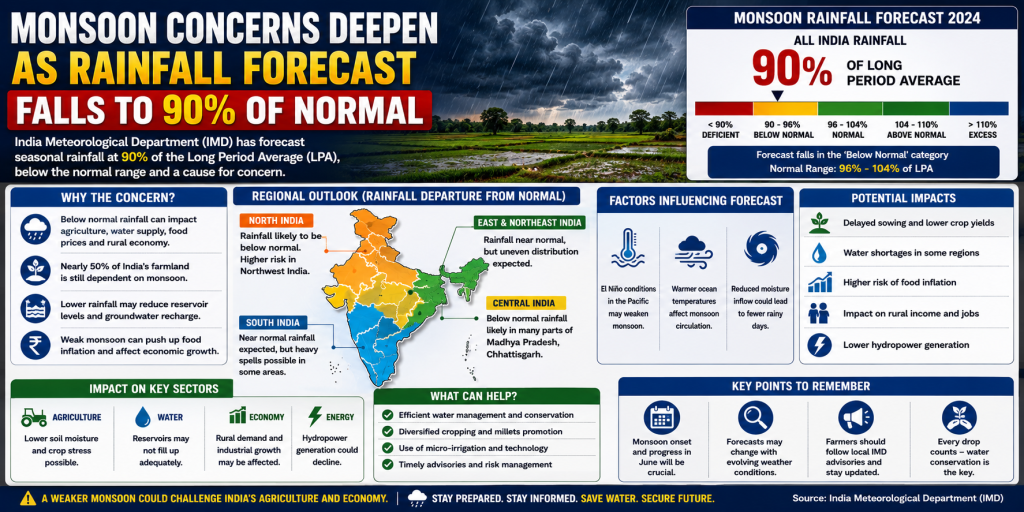
Fresh weather projections have raised concerns over India’s upcoming monsoon season after forecasts indicated that the country may receive only around 90% of normal rainfall. The latest monsoon rainfall forecast has triggered worries among farmers, policymakers, economists, and climate experts because the southwest monsoon plays a critical role in India’s agriculture, water supply, and overall economy.
Experts say below-normal monsoon rainfall could impact crop production, food inflation, reservoir levels, and rural incomes if rainfall distribution remains uneven during the season.
The monsoon season is considered the backbone of India’s agricultural economy, supporting millions of livelihoods across the country.
Why the Monsoon Is Crucial for India
The latest monsoon rainfall forecast is important because nearly half of India’s farmland still depends heavily on rain-fed agriculture.
A strong monsoon supports:
- Crop cultivation
- Drinking water supply
- Reservoir storage
- Hydropower generation
- Rural economic activity
Poor monsoon performance can therefore create widespread economic and agricultural challenges.
Forecast Indicates Below-Normal Rainfall
According to the latest monsoon rainfall forecast, India may receive rainfall levels around 90% of the long-period average during the upcoming season.
Meteorologists say this falls within the “below normal” category and may increase concerns regarding:
- Water shortages
- Agricultural stress
- Delayed sowing activity
However, experts note that regional rainfall distribution will remain equally important.
El Niño Conditions Remain Major Concern
Climate experts say the latest monsoon rainfall forecast is being influenced partly by global weather patterns such as El Niño.
El Niño conditions can:
- Weaken monsoon circulation
- Reduce rainfall intensity
- Delay monsoon progress
India’s monsoon system is highly sensitive to ocean temperature changes in the Pacific region.
Agriculture Sector Could Face Pressure
The weaker monsoon rainfall forecast may create difficulties for India’s agricultural sector, especially if rainfall remains inconsistent across key farming regions.
Crops most vulnerable to poor rainfall include:
- Rice
- Pulses
- Sugarcane
- Oilseeds
Farmers in rain-fed states may face increased uncertainty regarding sowing and irrigation.
Food Inflation Risks Increase
Economists say a weaker monsoon rainfall forecast could also increase food inflation risks.
Poor rainfall may affect:
- Vegetable production
- Grain supply
- Crop yields
Lower agricultural output can eventually push food prices higher across the country.
Reservoir Levels Under Watch
Authorities are closely monitoring water reservoir levels following the latest monsoon rainfall forecast concerns.
Below-normal rainfall could impact:
- Drinking water availability
- Irrigation systems
- Hydroelectric power production
Several states already face seasonal water stress during summer months.
Rural Economy May Be Affected
The latest monsoon rainfall forecast could also influence India’s broader rural economy.
A weaker monsoon can reduce:
- Farm incomes
- Rural spending
- Agricultural employment opportunities
Since agriculture supports a large portion of India’s population, monsoon performance directly affects economic stability in many regions.
Uneven Rainfall Distribution Also Important
Meteorologists say the total seasonal rainfall is not the only concern in the latest monsoon rainfall forecast.
Even if overall rainfall remains near 90%, problems may still occur if:
- Rainfall arrives late
- Long dry spells develop
- Heavy rain falls only in short periods
Uneven rainfall distribution can damage crops and reduce farming productivity.
Government Monitoring Situation Closely
Authorities are expected to monitor the evolving monsoon rainfall forecast carefully in the coming weeks.
Possible government responses may include:
- Water conservation measures
- Crop advisories for farmers
- Irrigation management planning
Agricultural agencies may also issue region-specific guidance during the sowing season.
Climate Change Adding Uncertainty
Experts believe climate change is making the monsoon rainfall forecast increasingly unpredictable.
India has witnessed:
- Extreme rainfall events
- Longer dry periods
- Irregular monsoon patterns
Climate scientists warn that future monsoon variability could become more severe.
Hope Still Remains for Improvement
Despite current concerns, weather experts say monsoon forecasts can still change depending on evolving oceanic and atmospheric conditions.
Meteorologists will continue tracking:
- Monsoon onset progress
- Arabian Sea activity
- Bay of Bengal systems
The final seasonal outcome may vary significantly across different regions.
Conclusion
The latest monsoon rainfall forecast indicating rainfall at around 90% of normal has deepened concerns regarding agriculture, water availability, inflation, and rural economic stability in India. While experts caution that forecasts may still evolve, below-normal rainfall projections have already increased pressure on policymakers and farmers ahead of the critical monsoon season.
As climate variability continues affecting weather patterns globally, India’s dependence on a healthy monsoon remains one of the country’s biggest environmental and economic challenges.
Add The News Pixel as a preferred source on Google- Click Here