
Akasa Air CEO on Surviving and Growing Despite Iran War Fallout: ‘Impact Limited, Growth Plans Remain Strong’

The ongoing geopolitical tensions in the Middle East and the fallout from the Iran conflict have created major challenges for global aviation, with airlines facing rising fuel costs, route disruptions, and operational uncertainty. However, the latest comments from Akasa Air leadership suggest that the airline remains confident about its growth plans despite the crisis.
The Akasa Air CEO Iran war fallout discussion gained attention after founder and CEO Vinay Dube stated that the airline continues to expand operations even as regional disruptions affect parts of its international network. According to Dube, the impact on Akasa Air’s operations has remained relatively limited, allowing the carrier to focus on long-term growth.
Middle East Tensions Affect Aviation Industry
The Iran conflict has significantly impacted airlines across the world due to concerns involving:
- Airspace restrictions
- Flight rerouting
- Rising aviation fuel prices
- Operational delays
Several carriers have been forced to adjust schedules and routes because of security concerns in parts of West Asia.
The Akasa Air CEO Iran war fallout remarks come at a time when many airlines are facing increased operational costs linked to geopolitical instability.
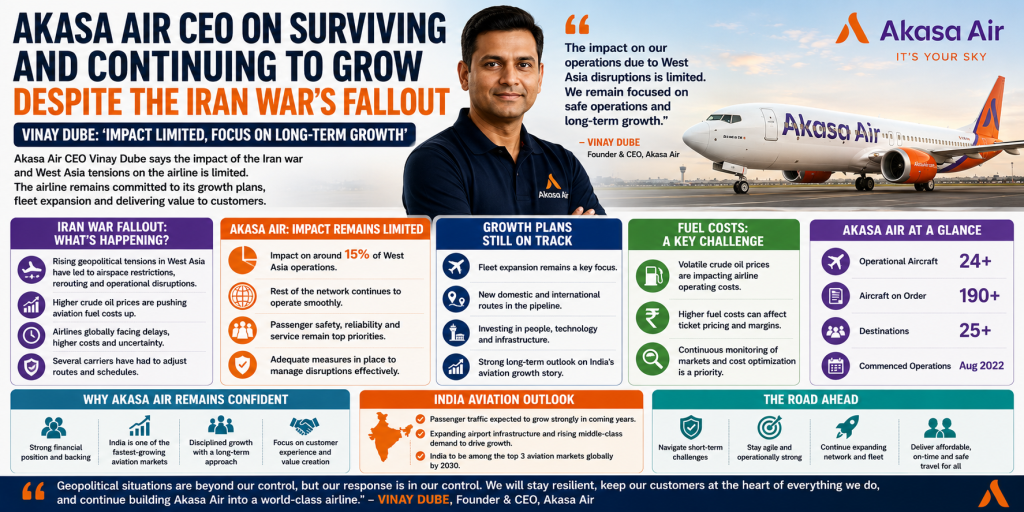
Akasa Air Says Impact Remains Limited
Speaking about the situation, Vinay Dube said that disruptions linked to West Asia have affected only a portion of Akasa Air’s operations.
According to the airline, around 15 percent of its West Asia operations have experienced disruptions due to the ongoing regional situation. Despite this, Akasa Air says its broader network remains stable and operational.
The Akasa Air CEO Iran war fallout statement highlighted that the airline has continued focusing on customer service, operational reliability, and network expansion.
Growth Plans Continue Despite Challenges
One of the key messages from the Akasa Air CEO Iran war fallout discussion is that the airline does not intend to slow down its long-term expansion strategy.
Akasa Air continues working on:
- Fleet expansion
- New domestic routes
- International network growth
- Infrastructure investments
The airline believes India’s aviation sector still offers significant long-term opportunities despite short-term geopolitical disruptions.
Rising Fuel Costs Remain a Concern
Aviation fuel prices remain one of the biggest challenges facing airlines during the ongoing Middle East crisis.
The Akasa Air CEO Iran war fallout issue is closely linked to crude oil market volatility, which directly affects airline operating costs.
Higher fuel prices can impact:
- Ticket pricing
- Profit margins
- Operational planning
Industry experts say airlines globally are monitoring energy markets very closely as regional tensions continue.
Akasa Air Remains Financially Confident
Despite industry challenges, Akasa Air maintains that its financial position remains strong.
Vinay Dube has repeatedly stated that the airline is well-capitalized and focused on disciplined expansion rather than aggressive short-term growth. The airline continues attracting investor confidence while strengthening its long-term business strategy.
The Akasa Air CEO Iran war fallout comments reflect confidence in the airline’s ability to manage temporary disruptions while maintaining growth momentum.
Fleet Expansion Remains Key Priority
Akasa Air continues pursuing major fleet expansion plans despite the uncertain global environment.
The airline currently operates dozens of aircraft and has a large number of additional aircraft on order for future growth. According to company leadership, fleet expansion remains central to Akasa Air’s long-term strategy.
This expansion is expected to support both domestic and international route development over the coming years.
Indian Aviation Industry Still Growing
The Akasa Air CEO Iran war fallout discussion also highlights the broader optimism surrounding India’s aviation market.
Industry leaders believe India could remain one of the world’s fastest-growing aviation markets because of:
- Rising passenger demand
- Expanding airport infrastructure
- Growing middle-class travel demand
Akasa Air expects these long-term trends to continue supporting growth despite temporary geopolitical challenges.
Operational Reliability Remains Focus Area
During periods of global uncertainty, airlines often prioritize operational stability.
Akasa Air says it remains focused on:
- Maintaining schedules
- Ensuring passenger safety
- Managing disruptions efficiently
The Akasa Air CEO Iran war fallout remarks suggest that operational resilience has become a major priority during the ongoing regional crisis.
Future Outlook Remains Positive
Despite concerns linked to the Iran conflict, Akasa Air leadership remains optimistic about future growth opportunities.
The airline believes that temporary geopolitical disruptions will not change the long-term fundamentals of India’s aviation sector. Management continues focusing on network growth, customer experience, and sustainable expansion.
Conclusion
The latest Akasa Air CEO Iran war fallout comments highlight how the airline is navigating one of the aviation industry’s most challenging geopolitical periods. While Middle East tensions have created operational and cost pressures across the sector, Akasa Air says the impact on its business remains limited and manageable.
With continued fleet expansion, strong financial backing, and confidence in India’s aviation growth story, the airline remains focused on long-term expansion despite the uncertainty created by the ongoing Iran conflict.
Add The News Pixel as a preferred source on Google- Click Here