
Petrol and Diesel From Air: Japan’s ENEOS Develops Revolutionary Alternative to Crude Oil

The global energy industry may be heading toward a major transformation after reports revealed that one of Japan’s largest energy companies has successfully developed technology capable of producing fuel from carbon dioxide captured directly from the air. The breakthrough is being viewed as a possible game-changer amid rising concerns over oil supply disruptions, fuel inflation, and climate change.
The development has sparked global interest because the technology could potentially reduce dependence on crude oil imports while supporting cleaner energy production.
Which Company Developed the Technology?
According to reports, the innovation is linked to ENEOS Holdings, one of Japan’s largest energy corporations.
The company is reportedly working on advanced carbon recycling technologies capable of converting carbon dioxide into synthetic fuels such as:
- Petrol
- Diesel
- Sustainable aviation fuel
Industry experts say the project is part of Japan’s broader push toward carbon neutrality and alternative fuel development.
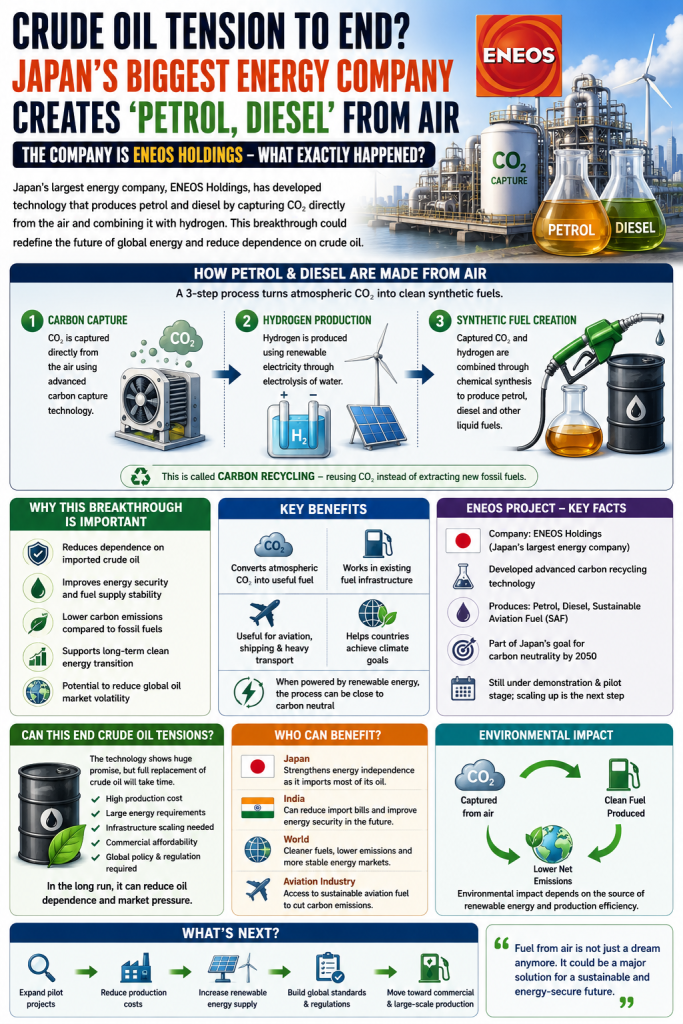
How Is Petrol and Diesel Being Made From Air?
The technology behind the breakthrough involves capturing carbon dioxide directly from the atmosphere and combining it with hydrogen produced through renewable energy processes.
The system generally works in three stages:
Carbon Capture
CO₂ is extracted directly from the air using carbon capture technology.
Hydrogen Production
Hydrogen is produced using renewable electricity through electrolysis.
Synthetic Fuel Creation
The captured carbon and hydrogen are chemically combined to create synthetic liquid fuels that can function similarly to conventional petrol and diesel.
Experts describe this as a form of “carbon recycling” because the process reuses atmospheric carbon instead of extracting fresh fossil fuels.
Why the Technology Is Important
The development is attracting attention because global crude oil markets remain highly vulnerable to geopolitical tensions, wars, and supply chain disruptions.
The new fuel technology could potentially help:
- Reduce oil import dependency
- Lower carbon emissions
- Improve energy security
- Stabilize fuel supply chains
Countries heavily dependent on imported oil are closely watching advancements in synthetic fuel technology.
Can This End Crude Oil Tensions?
While experts believe the innovation is promising, they caution that it may take years before synthetic fuels can replace conventional crude oil at large scale.
Challenges still include:
- High production costs
- Large energy requirements
- Infrastructure scaling
- Commercial affordability
However, if costs decline over time, synthetic fuels could reduce global dependence on fossil fuel markets significantly.
Japan’s Push Toward Clean Energy
Japan has been aggressively investing in next-generation energy technologies because the country imports most of its crude oil requirements.
The government and private sector are supporting projects related to:
- Hydrogen fuel
- Carbon capture
- Synthetic fuels
- Renewable energy systems
Japan aims to reduce carbon emissions while improving long-term energy independence.
Could India Benefit From Similar Technology?
Countries like India could also benefit from future synthetic fuel advancements because India remains one of the world’s largest crude oil importers.
Experts believe technologies like fuel-from-air systems may eventually help:
- Reduce fuel import bills
- Improve energy security
- Support climate goals
India is also investing heavily in green hydrogen and clean energy infrastructure.
Environmental Impact of Fuel From Air
One major advantage of synthetic fuel technology is its potential environmental benefit.
If powered by renewable energy, the process may:
- Reduce net carbon emissions
- Recycle atmospheric CO₂
- Lower dependence on fossil extraction
However, experts note the environmental impact depends heavily on how the electricity and hydrogen used in production are generated.
Aviation Industry Showing Interest
Synthetic fuel technologies are also gaining attention from the aviation sector.
Airlines are exploring sustainable aviation fuels because the industry faces increasing pressure to reduce emissions while maintaining long-distance travel operations.
Fuel produced from captured carbon may eventually support cleaner aviation infrastructure.
Challenges Before Mass Adoption
Despite the excitement, experts warn several major obstacles remain before synthetic petrol and diesel become mainstream.
These include:
- Expensive production facilities
- Need for massive renewable energy capacity
- Competition from electric vehicles
- Global regulatory frameworks
Commercial-scale deployment could still take several years.
Future of Global Energy Markets
The emergence of fuel-from-air technology highlights how the future energy market may become increasingly diversified.
Experts predict future fuel systems may combine:
- Renewable energy
- Hydrogen infrastructure
- Carbon recycling technologies
- Electric mobility
Synthetic fuels could eventually become part of a broader clean-energy transition.
Conclusion
The breakthrough by ENEOS Holdings in creating petrol and diesel from atmospheric carbon dioxide has sparked fresh optimism about the future of clean energy and alternative fuels. While the technology is still evolving, experts believe it could eventually help reduce crude oil dependence, strengthen energy security, and support global climate goals.
Although large-scale commercial adoption may still take time, fuel-from-air technology is increasingly being viewed as one of the most promising innovations in the future energy industry.
Also read: Cheapest Countries to Buy Gold: Check India’s Rank in Global Gold Price List 2026
Add The News Pixel as a preferred source on Google- Click Here